Parts of this page are machine-translated from Chinese.
What Is Body Feng Shui?
Decode your body feng shui: an inner frequency guide from "forcing it" to "going with the flow." We often say life is a journey of leveling up through challenges. But have you ever wondered why sometimes your mind clearly knows the direction, while your body feels like it's carrying sandbags—always short of strength? In fact, this is closely related to your...
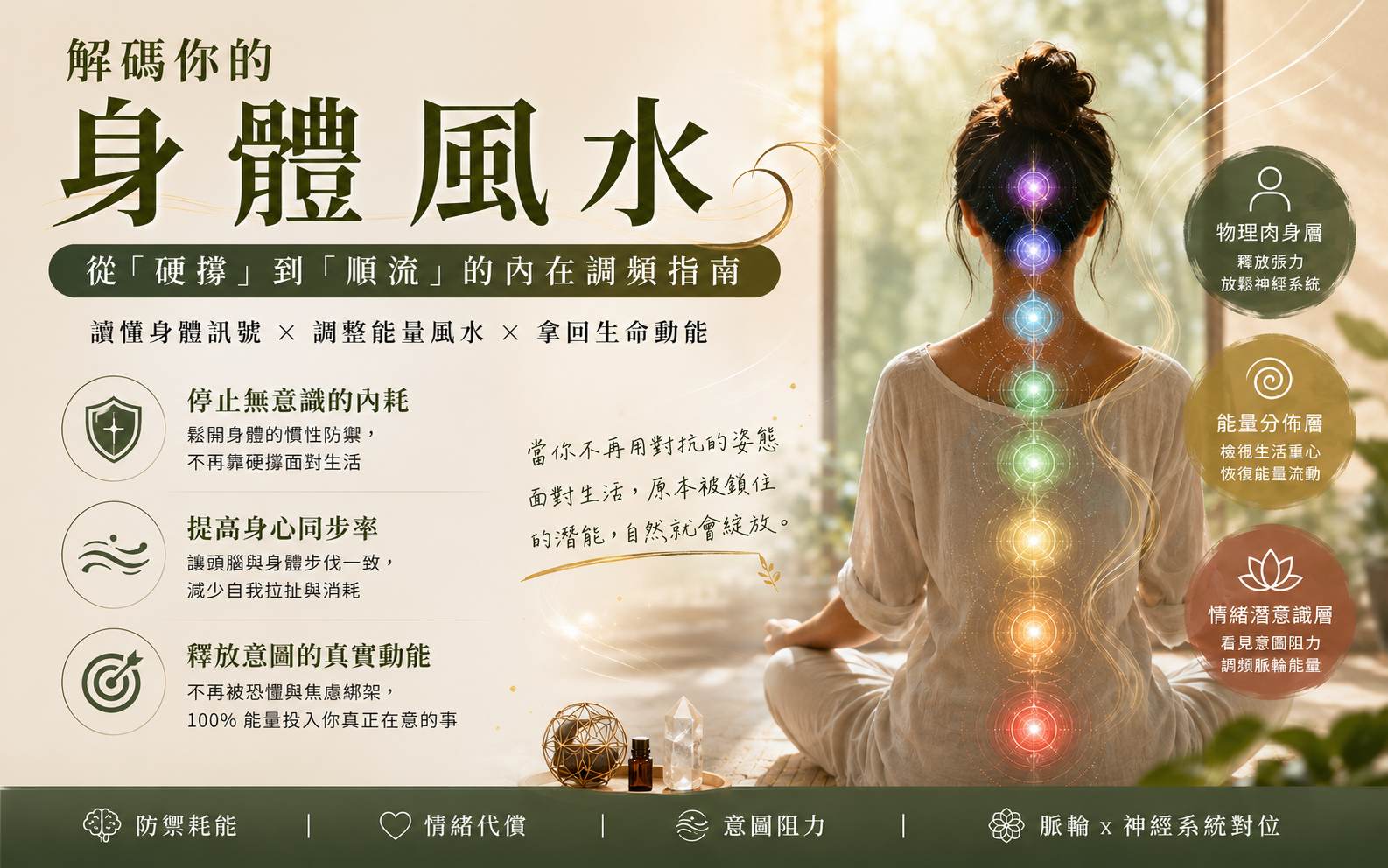
Decode your body feng shui: an inner frequency guide from "forcing it" to "going with the flow"
We often say life is a journey of leveling up through challenges. But have you ever wondered why sometimes your mind clearly knows the direction, while your body feels like it's carrying sandbags—always short of strength?
In fact, this is closely related to your "body feng shui."
- What is body feng shui? Why do we need to understand it?
Body feng shui is your body's inner "energy distribution map" and "emotion map." Just as a house has layout and airflow patterns, our bodies have their own energy operating logic. When we face pressure, anxiety, or grievance in life, the body automatically produces corresponding defense mechanisms—for example: a clenched jaw to hold the situation together, a tightened gut from lack of safety, or stiff shoulders and neck to defend against outside judgment.
We need to understand body feng shui because **"the body is most honest."** Often the mind uses reason to deceive itself—"I'm fine, I can still hold on"—but the body records the full cost. When we read the body's signals, we can see where our life energy is actually flowing, and what has been quietly intercepting our forward momentum.
- How is traditional feng shui different from "body feng shui"? How do they affect each other? Which should we change first?
Traditional feng shui looks at the "outer environment": changing home layout, placement, or orientation to influence a person's energy field and fortune. Body feng shui looks at the "inner environment": decoding tension, tightness, and energy stagnation points in the body to adjust your nervous system and survival patterns.
How do they affect each other? People are products of their environment. A repressive outer environment (poor traditional feng shui) keeps the nervous system chronically tight and damages your body feng shui. Conversely, when your body feng shui is in a state of "over-alert" or "energy drain," even in a mansion with excellent feng shui you may still feel anxious, unable to relax, and unconsciously make poor decisions.
Which should change first? The answer: adjust "body feng shui" first. Your body is your soul's only vehicle in this world, and also your most intimate "feng shui." Changing the outer environment sometimes takes huge cost and timing, but fine-tuning the body remains in your hands. When your inner layout opens up and the nervous system relaxes, the filter through which you see the world changes—and only then does adjusting the outer environment work with half the effort for twice the result.
- What are the benefits of adjusting body feng shui?
Simply put: **"taking back your real life momentum."**
Before adjustment, about 70% or more of our daily energy goes into invisible "defense drain" (constant readiness to fight) and "emotional compensation" (digesting anxiety and repression). That is why you can do almost nothing and still feel emptied out after work.
Benefits of adjusting body feng shui include:
- Stop unconscious inner drain: Release the body's habitual defenses so you no longer rely on "gritting your teeth and forcing it" to face life.
- Raise mind-body sync: Align "goals the mind wants to sprint toward" with "load the body can carry," reducing self-pulling.
- Release the real momentum of intention: When you no longer spend energy resisting inner fear and anxiety, you can put 100% of your energy precisely into what you truly want to complete (intention).
- Which layers of a person does body feng shui adjust?
Adjusting body feng shui is not simply stretching or massage—it is a deep "body-mind alignment." It covers three main layers:
- Physical body layer (tension and pace): Find where tension and tightness show up most (e.g., shoulders/neck, chest, lower body). These are not mere fatigue—they are the "armor" you use to face the world. Adjusting them helps tight muscles and the nervous system relearn relaxation.
- Energy distribution layer (review of life's center of gravity): Check whether your energy is over-concentrated on "busy seeking answers (future and ideals)," "busy dealing with the outside (society and self)," or "busy seeking safety (body and instinct)." Through adjustment, energy stops stuck in a single dimension and healthy flow returns.
- Emotion and subconscious layer (chakras and defense patterns): Behind every tightness sits a subconscious fear (e.g., not daring to refuse others, fearing you are not enough). Body feng shui maps to different energy centers (chakras), helping you see these invisible "intention resistances," and supporting stable frequency in daily life through dedicated scent or anchoring tools (such as orgonite).
In summary: Body feng shui teaches us to stop those old survival moves. When you no longer face life in a posture of resistance, the potential that was locked away naturally begins to bloom.